




In 1960, the writer C.S. Lewis lost his wife Joy Davidman to cancer. They had been married for only four years — a late and unexpected love that transformed both of them. What followed her death was not what Lewis anticipated.
He had written extensively about suffering from a philosophical distance. He had theorised about grief, explained it, made it comprehensible in the abstract. Then Joy died, and he found that none of it applied.
Grief felt like fear
In the raw private journals he kept in the weeks after her death — later published as A Grief Observed — Lewis described an experience that contradicted everything he had expected. The most striking observation, and the one that has resonated with bereaved people for decades since, was this: grief did not feel like sadness. It felt like fear.
“No one ever told me that grief felt so like fear. I am not afraid, but the sensation is like being afraid. The same fluttering in the stomach, the same restlessness, the yawning. I keep on swallowing.”
He described an inability to concentrate, a sense of unreality, the feeling of a door slamming shut. He described how the world continued indifferently around him — people shopping, talking, making plans — while he moved through it as though behind glass.
He was not writing for publication. He was writing to survive. The notebooks were a private act of making sense of something that refused to make sense.
What this means for bereaved parents today
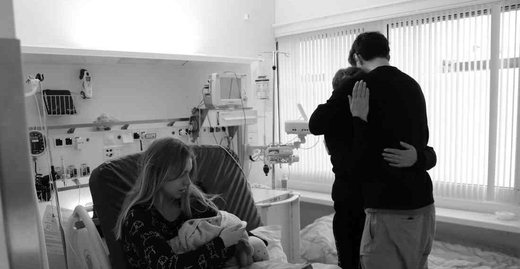
Bereaved parents who describe their experience in the days and weeks after a pregnancy or infant loss often reach for similar language. Not sadness — that word is too quiet, too contained. Something more physical. A hollowness. A constant low-level alarm. The sense that the ground is not quite solid.
What Lewis described in 1960 is now understood more clearly through neuroscience. Grief activates the same neurological pathways as fear and threat response. The body does not distinguish between types of loss. It responds to the absence of someone it has been wired to protect, to care for, to love — as though to a danger that cannot be located or addressed.
This is why bereaved parents so often describe feeling unable to eat, unable to sleep properly, unable to concentrate. These are not signs of weakness or of grief going wrong. They are the body responding to something real and enormous, in the only way it knows.
Grief is not linear — and Lewis knew it
One of the most honest things about A Grief Observed is that it does not resolve neatly. Lewis goes through periods of relative calm only to be ambushed again. He observes himself with something close to detachment — noting the contradictions, the regressions, the unexpected moments when grief returns with full force from a direction he did not see coming.
This is the experience that bereaved parents describe at due dates, at anniversaries, at the sight of something ordinary — a certain quality of afternoon light, a song on the radio, someone else's baby in a supermarket. Grief does not follow a path. It circles.
What Lewis gave those who came after him was not a solution. It was permission — to feel what they actually felt, to describe it accurately, and to trust that the chaos of grief was not a sign that they were grieving wrongly.
This article draws on the published text of A Grief Observed by C.S. Lewis (Faber & Faber, 1961) and on publicly available biographical accounts of his life and marriage. All quotes are from Lewis's own published writing. The neuroscience references reflect peer-reviewed research on grief and the stress response system, available in the MIMATIS research library at mimatis.org/research.